IDENTIFY THE KEY LEVEL
Where are you interested in trading?
- Daily, weekly or monthly levels
- Session highs and lows
- Opening ranges
- Swing liquidity
- VWAP
- POC, VAH and VAL
- Custom levels
Define the context instead of deciding in the moment.
THE MECHANICAL TRADER
Build strategies with key levels, liquidity, session ranges, entries and trade management — and define exactly which rules should apply inside TradingView.
Backtest the combination over a sample size. See how the rules have actually behaved historically. Then follow them manually or automate execution.
For me, a trading strategy comes down to three things.
Where are you interested in trading?
Define the context instead of deciding in the moment.
What exactly has to happen before you enter?
A trade either meets the rules or it doesn't.
What happens after entry?
The entry is only one part of the strategy.
TMT combines the level, the entry and the management into one complete set of rules that can be backtested in TradingView.
Not just the entry.Not just a signal.The trading plan.
The problem isn't that the questions are bad.
The problem is that you don't know the answer.
And if you don't know the answer, it often means you don't have enough data to know which rule you should actually follow.
If the “right” liquidity, FVG or market bias changes from trade to trade, it becomes difficult to know whether you have an edge — because you are no longer testing the same thing.
With TMT you can define the same key level, the same entry conditions and the same trade management, then backtest them again and again.
Not to find the perfect trade.
To find out whether the same rule set can generate a statistical edge in the current market environment.
If the answer changes every time you look at the chart — what are you actually testing?
Technical analysis cannot predict exactly what will happen on the next trade.
What it can do is help you identify a recurring pattern or rule set that may have a statistical edge over a larger sample size.
Think of it like a biased coinflip.
If a setup has historically produced a certain win rate and a certain average RRR, that does not mean the next trade will be a winner. It also does not mean wins and losses will come in a neat or predictable order.
All it means is that over many trades, the same setup may have a positive expectancy.
That is why we backtest.
Not to predict the next trade — but to measure whether a recurring pattern actually seems to have an edge over time.
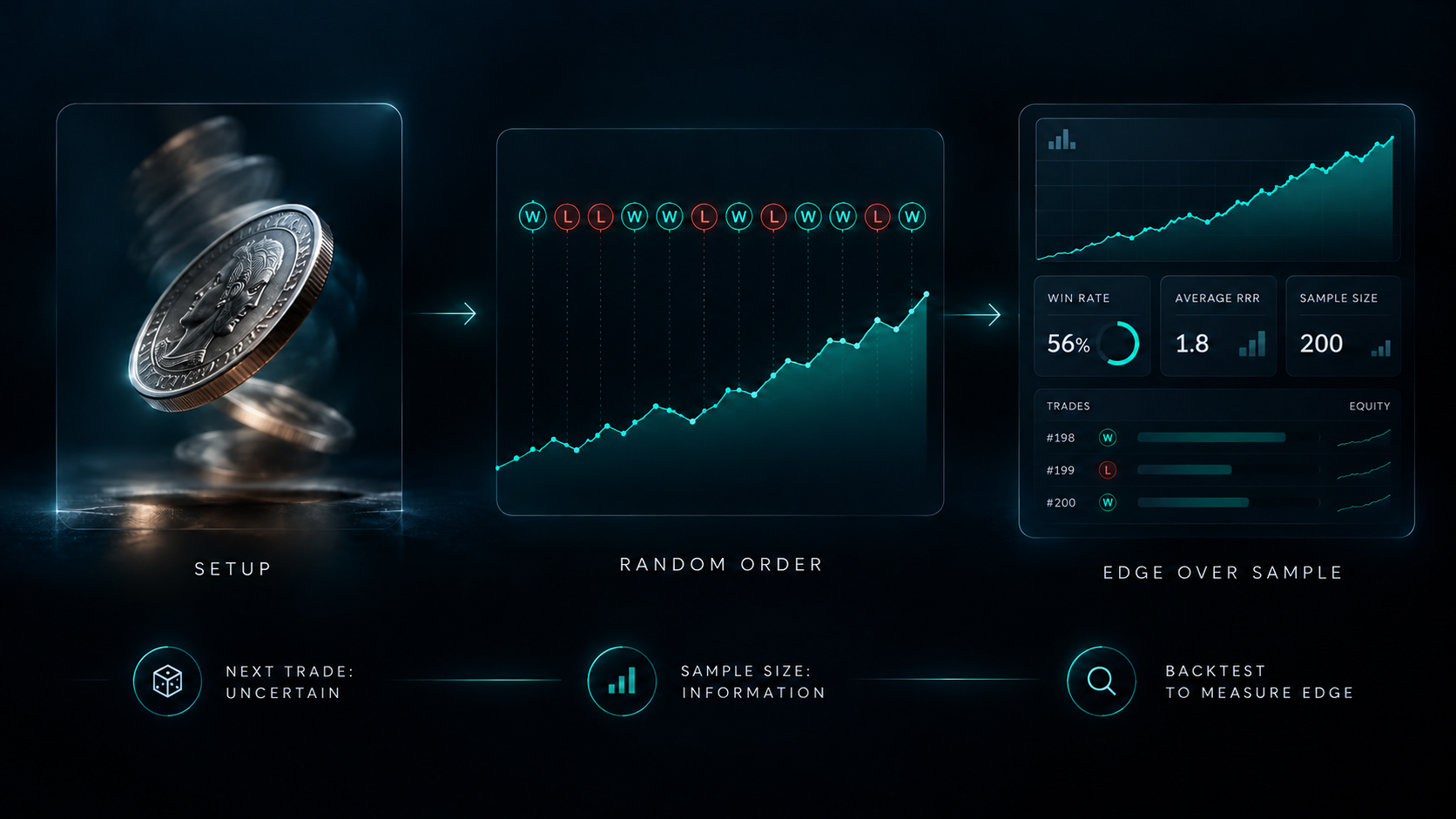
Illustrative example — the figures are not TMT performance results.
You are not looking for the next guaranteed trade. You are looking for a repeatable edge over a sample size.
A setup can look incredible on a chart and still have no measurable edge.
Technical analysis is about estimating outcomes across many trades — a sample size — not predicting the result of one trade.
When every rule is defined, you can test hundreds of occurrences instead of remembering the examples that looked good.
You can ask real questions:
TMT doesn't guarantee that a strategy will keep working in the future. Markets change.
When market dynamics change and backtests no longer show good results, a mechanical plan gives you clear rules to adjust and retest. Does the SL need more room? Should you reduce TP or use a trailing stop?
TMT makes it quick and easy to test those changes across many trades before deciding how to adapt your plan — instead of improvising during a trade.
You don't need to know what happens next.You need rules you can test and follow.
TECHNICAL ANALYSIS ≠ PREDICTION
No chart pattern, indicator, mechanical rule or subjective read can guarantee what happens after the next entry.
Once you are in a trade, anything can happen. Thousands of traders and algorithms keep buying and selling, new information can enter the market, liquidity can change — and none of us can know in advance exactly how every participant will act.
That doesn't make technical analysis useless. Its purpose is to estimate outcomes across many trades — a sample size — by defining recurring market conditions and testing whether they have produced a statistical advantage.
If the setup changes from trade to trade, you are no longer measuring the same thing.
You are not trying to predict the next trade.You are estimating outcomes across many trades with the same conditions.
A lot of trading tools start with the answer: BUY. SELL. LONG. SHORT.
But the trader often has very little idea why the signal exists. Maybe it comes from an oscillator. Maybe several hidden confluences. Maybe a proprietary algorithm.
Typical signal script
TMT
Every trade should be explainable because every trade came from rules you chose.
TMT doesn't try to predict the market for you.It helps you define what you believe is an edge — and test whether the data agrees.
TMT is where you turn a trading idea into exact rules and test the entire strategy inside TradingView.
The purpose isn't to add more indicators to your chart. It's to make your trading measurable — from context and entry to risk, exits and trade management.
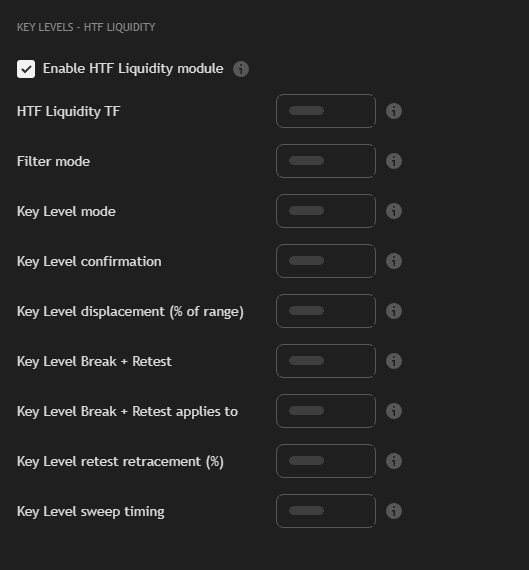
A few examples from the actual TMT settings. The point is not one preset — it is that the same framework lets you define context, entry, risk and management as explicit rules.
I spent years trying to become better at subjective trading. I kept making the same mistakes: revenge trading, FOMO and moving my SL and TP. Without defined, backtested rules, I did not trust my ‘strategy’ — which was not really a strategy at all.
That makes it extremely difficult to know whether the strategy failed — or whether you simply stopped following it.
It's also important to understand that it's very hard to find a mechanical strategy that has performed well in every market, in every period. But that isn't the point either.
The point of mechanical trading isn't to build a system that never has a drawdown or never needs adjusting. The point is to decide the rules before the trade happens — so that I can't start changing the plan once emotions take over.
FOMO, revenge trading, moving the SL, taking TP too early or holding a trade too long are usually different expressions of the same underlying problem: fear. Fear of missing a trade, fear of losing, fear of being wrong or fear of leaving money on the table.
A mechanical strategy doesn't remove uncertainty in the market. It reduces my ability to react to that uncertainty in a bad way.
Mechanical trading gives me a cleaner standard: either the trade met my rules or it didn't. That doesn't remove losses. It doesn't remove uncertainty. And it doesn't guarantee profitability.
It removes my ability to rewrite the strategy in the middle of the trade.
My job isn't to be right on the next trade.My job is to execute a defined edge consistently over a sample.
TMT can create TradingView alerts that can be connected to compatible external execution solutions. But automation is optional. Personally, I use both.
You can use the rules as a structured plan and execute the trades yourself, or automate the strategy when that makes more sense.
The important part is not who clicks the button. The important part is that the same rules are followed.
TMT IN PRACTICE
A real NAS100 example from TMT with entries, exits, key levels and trade-management logic plotted directly in TradingView.
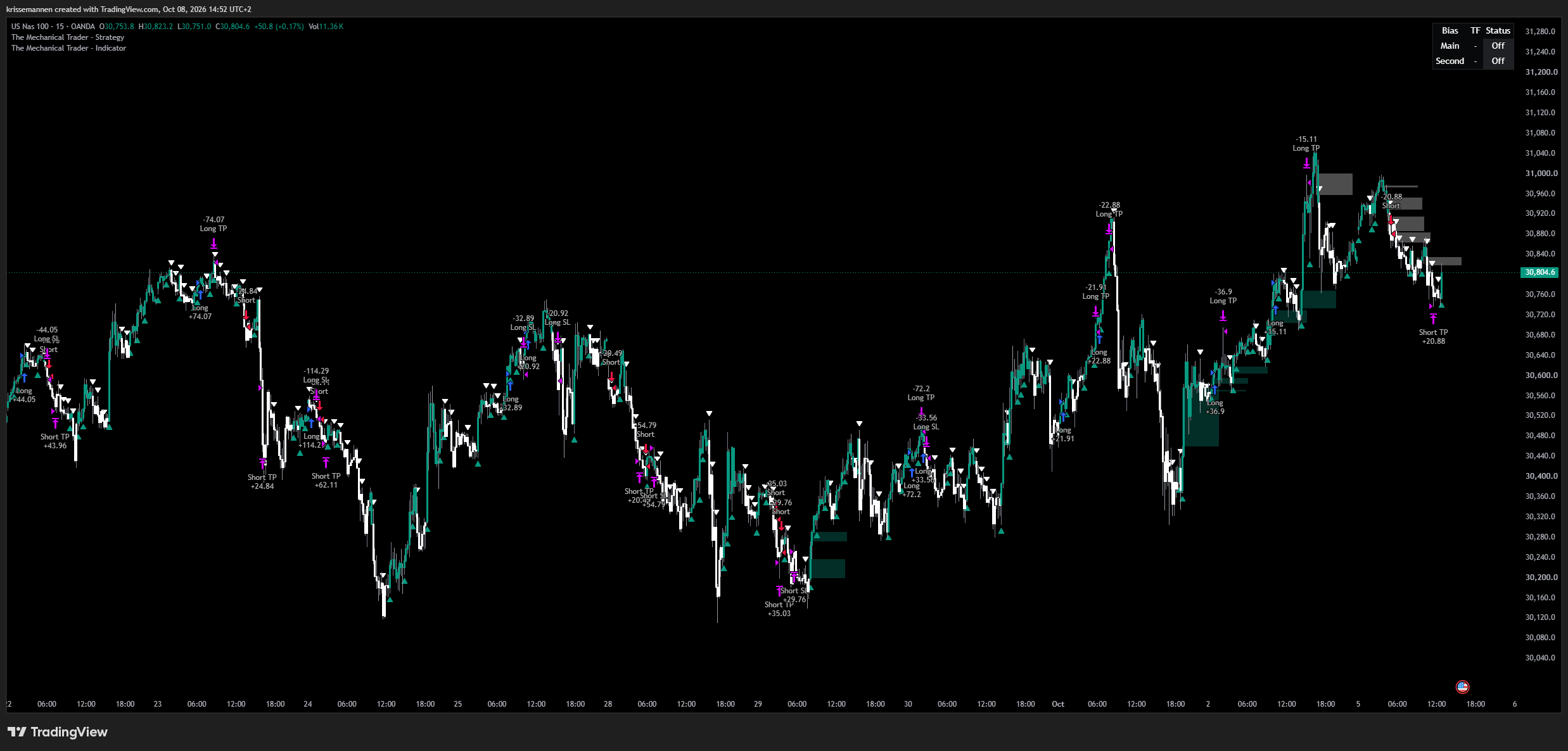
TMT is built for creating your own strategies. But TMT + ORB also includes two complete mechanical strategies built using the same philosophy: a defined level, a defined entry, defined risk and management, backtested rules.
They are practical examples of what a fully specified strategy can look like inside TMT.
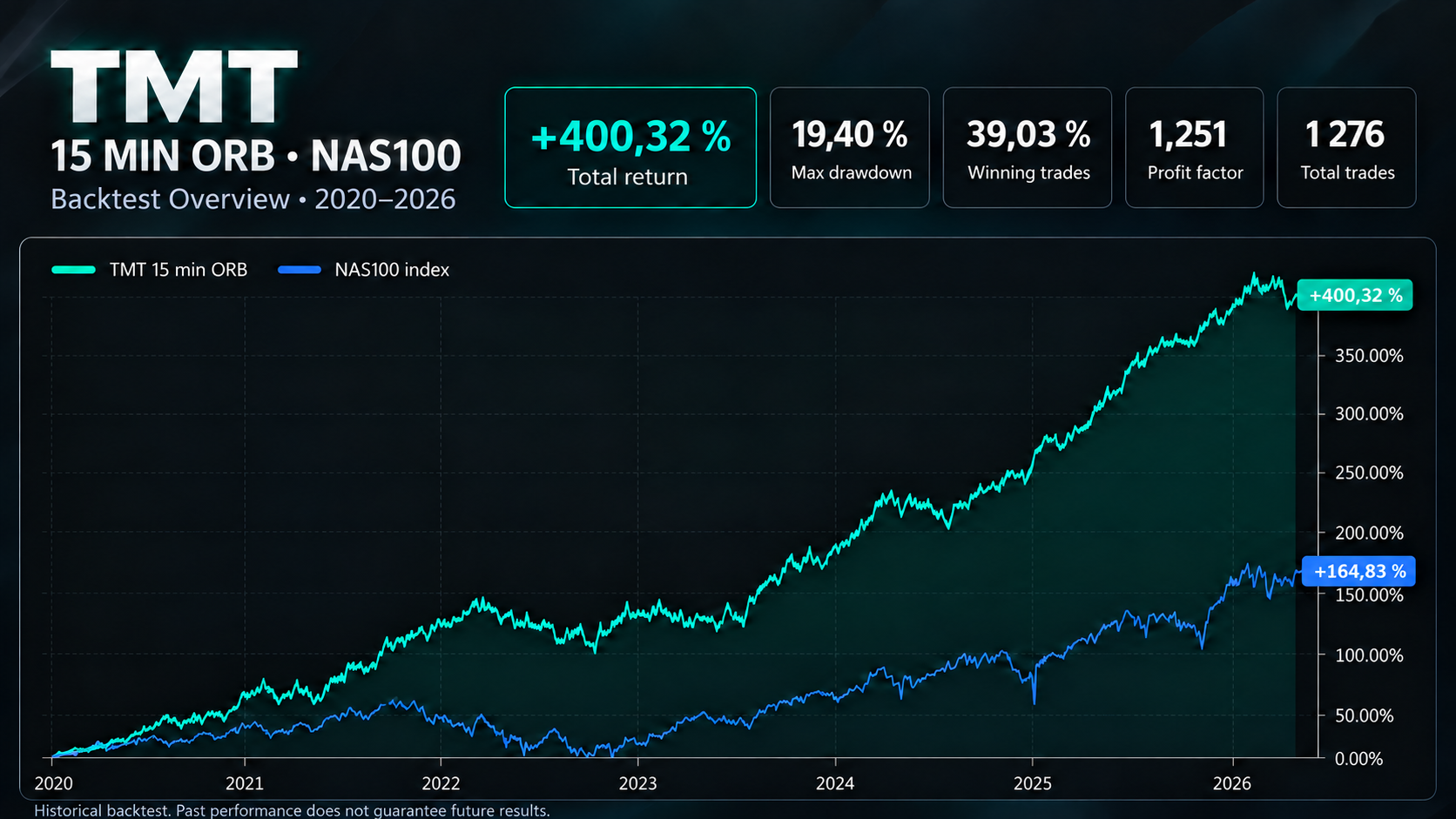
NAS100 · Approximately 6 years of historical backtesting.
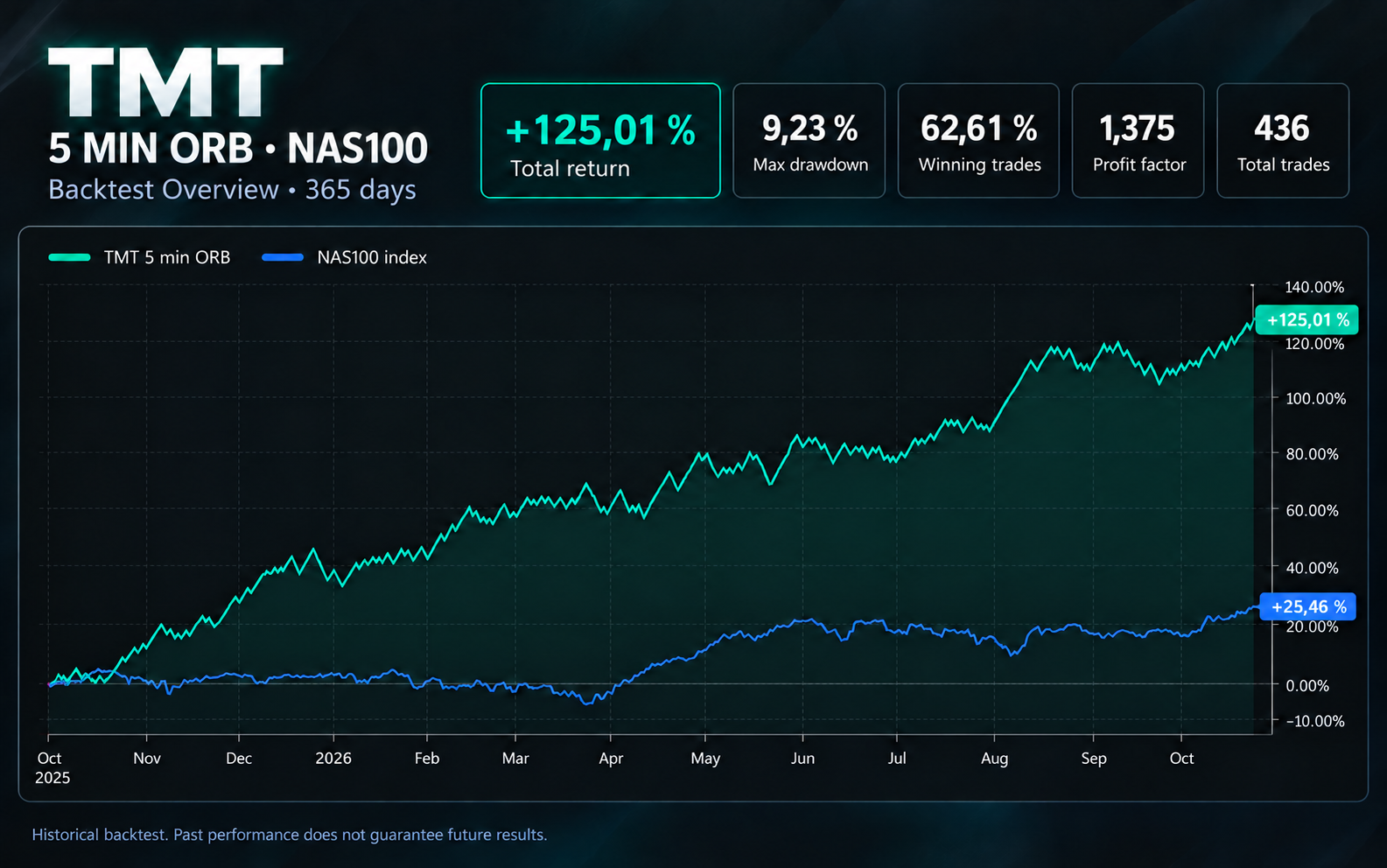
NAS100 · 365-day historical backtest.
The two strategies were tested across different periods, so their statistics should not be directly compared. Historical or simulated performance does not guarantee future results.

I didn't build The Mechanical Trader because I found a magic strategy. I built it because I got tired of trading on feeling.
I started trading without a real plan, lost money, consumed endless trading content and spent a long time believing that becoming a better trader meant becoming better at predicting the market.
The biggest change in my trading came when I stopped thinking that way. I started thinking in probabilities instead: define the edge, define the risk, take the trade, repeat it over a sample.
The Mechanical Trader became my way of putting that philosophy into software — everything I personally wanted to test, collected into one framework.
I still don't know what the next trade will do. That's the point.
Inspired heavily by the probability-based trading philosophy I learned from Mark Douglas.
Define the edge.Define the risk.Follow the rules.
699 SEK / month · normal price
For traders who want to turn their own trading ideas into mechanical, testable strategies.
5 founding spots per plan — 10 spots total.
Keep the founding price for as long as your subscription remains active.
Cancel anytime.
999 SEK / month · normal price
The complete TMT framework plus two ready-to-use mechanical ORB strategies.
5 founding spots per plan — 10 spots total.
Keep the founding price for as long as your subscription remains active.
Cancel anytime.
FAQ
TMT is a TradingView framework for turning trading ideas into fully defined mechanical strategies. You choose the market context, entry conditions, risk and trade-management rules, then backtest the complete combination.
No. That is almost the opposite of the idea. TMT doesn't give you unexplained buy and sell signals. You define the logic that creates the trades. The goal is that you should understand exactly why a trade exists.
The core TMT product is a tool for building and testing strategies, not a promise of profitability. TMT + ORB additionally contains two ready-made mechanical strategy setups. No strategy or backtest guarantees future performance.
It might. Markets change and historical performance does not guarantee future results. But remember that a historical mechanical edge can also perform better than it has historically — people often focus only on the downside. That is one reason I prefer mechanical rules: they give you something objective to measure. If the strategy starts behaving differently, you can test changes such as a wider SL, a smaller TP, trailing, different confluences, filters or key levels, then evaluate those changes over a meaningful sample size before changing the plan.
There is no single correct number. You need a sample size that you are personally comfortable with and that makes sense for your timeframe and setup. I would say at least 20–25 trades for an initial indication, but personally I am often much more comfortable with 100–200 trades. The important thing is that the sample does not have to be finished just because you start using the strategy. A strategy that starts with 20–25 trades can keep being built over time with more backtested and new trades.
You can. There are extremely successful discretionary traders. Many people think subjective trading is easier, but in my experience it is much harder to stay consistent over the long term. TMT is for traders who prefer to reduce interpretation and decide the rules before the trade happens. For me personally, that makes it much easier to separate the strategy from fear, FOMO and decisions made in the moment.
Yes. Mechanical trading and automated trading are not the same thing. You can use TMT to define and track a strategy while executing every trade manually.
TMT supports TradingView alerts that can be connected through webhooks to compatible execution solutions. Automation is optional.
No. The rules are configured through TMT's TradingView settings.
Yes. The subscription can be cancelled at any time.
Define the setup.Test the sample.Learn what works.Follow the rules.
Get The Mechanical TraderFounding offer from 399 SEK/month · 5 spots per plan · 10 total · Cancel anytime